
Every nonprofit leader can recite the mission-critical numbers: membership revenue, program spend, reserve targets. Far fewer can tell you, with confidence, exactly how a gift moves from the moment it arrives to the moment it shows up correctly in the general ledger. That gap is where money quietly disappears, donors quietly lose trust, and audits quietly get harder than they need to be.
The function most likely to live in that blind spot is "caging", the process of receiving, recording, and depositing gifts, and it's rarely thought of as a finance function at all. It usually sits with development or membership staff, while finance sits one department over, reconciling whatever numbers eventually land on their desk. In 2026, with donor and member scrutiny higher than ever and every organization stretched thin, that separation is one of the most avoidable risks on your balance sheet.
What Caging Actually Is and Why It's a Finance Problem
Caging is the operational backbone of every gift and dues payment your organization receives: opening the mail, processing the check or card transaction, recording who gave what and for what purpose, depositing the funds, and generating the acknowledgment or tax receipt. It sounds administrative. It isn't. Every one of those steps touches numbers that finance is ultimately accountable for: revenue recognition, restricted versus unrestricted fund coding, bank deposits, and the data that feeds your Form 990 and your audit.
When caging is treated as a development-only task, finance ends up reconciling after the fact instead of validating in real time. That's the moment small errors, a mis-coded restricted gift, a duplicate entry, a deposit that doesn't match the batch report, stop being administrative annoyances and start being audit findings.
Where the Disconnect Actually Hurts You
- Restricted funds get miscoded. A gift designated for a specific program that gets coded as general revenue isn't just a bookkeeping error; it's a compliance and donor-trust issue if it's ever noticed by the donor or an auditor.
- Reconciliation becomes a monthly fire drill. When gift records and bank deposits are tracked in two different systems by two different teams, month-end close turns into a search for why the numbers don't match, instead of a routine confirmation that they do.
- Tax receipts go out late or wrong. Donors expect fast, accurate acknowledgment, and inaccurate receipts create real tax exposure for them, not just an inconvenience.
- Audit prep becomes a scramble. Auditors want a clean, traceable line from gift receipt to deposit to ledger entry. If that trail runs through two disconnected processes, audit season gets longer and more expensive every single year.
- Leadership loses real-time visibility. Board members and finance committees want to know where revenue actually stands. If gift data lags by weeks because it has to be manually reconciled into the books, you're making decisions on stale numbers.
- Fraud risk goes up, not down. Strong internal controls depend on segregation of duties; the person opening the mail shouldn't be the same person recording the gift and approving the deposit. Informal, siloed processes often blur those lines without anyone intending it.
None of this is a reflection of your team's effort. It's what happens by default when gift processing and financial accounting are treated as two separate workflows instead of one continuous one.
What It Looks Like When Caging and Finance Are Actually Connected
Organizations that close this gap don't necessarily add headcount, they redesign the handoff so caging and finance are effectively one process with two functions:
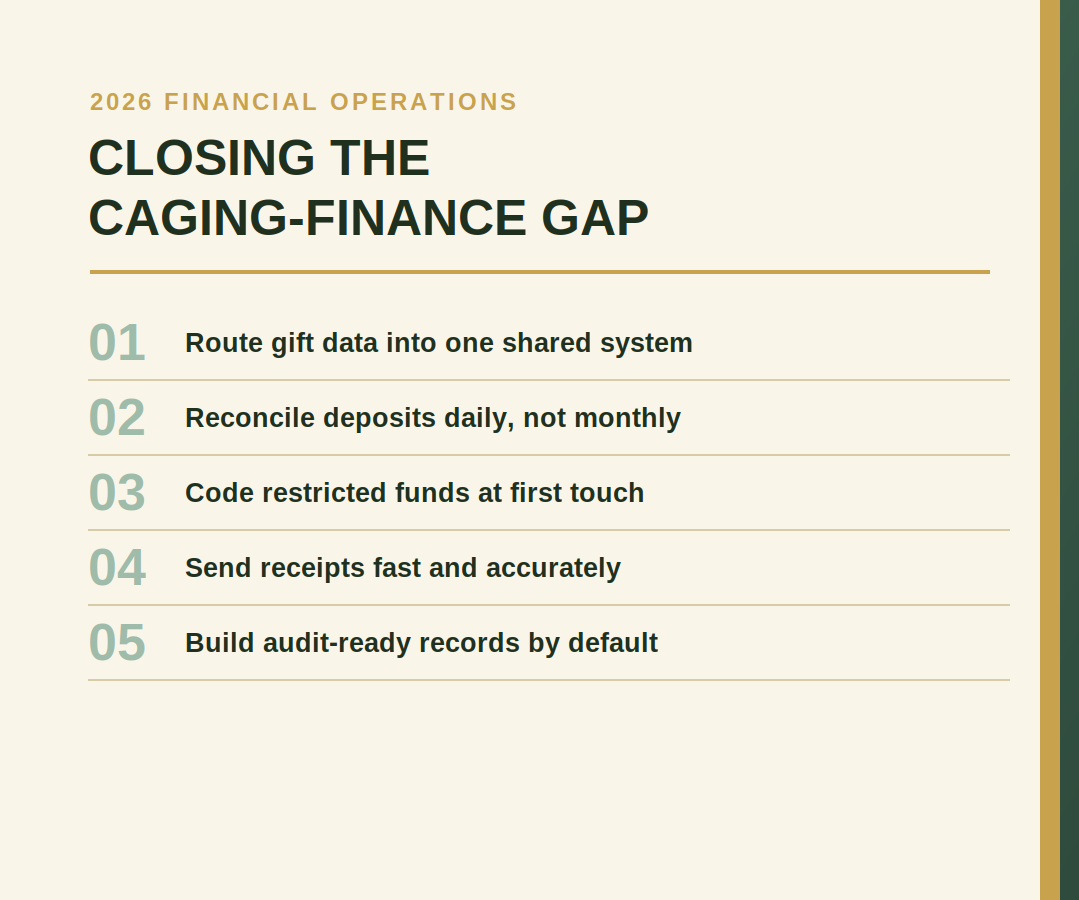
- A single source of truth. Gift and dues data flows directly into the same system your finance team uses for reporting, instead of living in a separate spreadsheet or CRM that gets reconciled later.
- Daily, not monthly, reconciliation. Deposits are matched to gift records as they happen, so discrepancies get caught in days, not discovered in an audit six months later.
- Correct fund coding from the first touch. Restricted, unrestricted, and designated gifts are coded correctly at the point of entry, not corrected after the fact.
- Receipts and acknowledgments that go out fast and accurately, because the same clean data used for the ledger is used for the donor-facing communication.
- Audit-ready records by default. When every gift has a clear, traceable path from receipt to deposit to ledger, your annual audit becomes a confirmation exercise instead of an investigation.
- Real-time revenue visibility for leadership and the board, so financial conversations are based on where things actually stand.
Practical Steps to Close the Gap
You don't need to overhaul your entire operation to fix this. A few concrete moves go a long way:
- Map the current handoff. Walk through exactly what happens between a gift arriving and it showing up in your financials. Most leaders are surprised by how many manual steps and separate systems are involved.
- Assign clear ownership of reconciliation, and make it a weekly cadence, not a monthly one.
- Standardize fund coding rules so restricted and designated gifts are classified consistently, regardless of who's processing them that day.
- Put segregation of duties in writing — who opens, who records, who deposits, who approves, even if it's the same small team wearing different hats on different days.
- Give finance visibility into gift data in real time, not on a delay, so reporting reflects reality.
How Bearing Tree Closes This Gap for You
This is precisely the seam Bearing Tree was built to close. Because Bearing Tree provides both Development Operations & Research and Finance & Accounting under one integrated model, donation caging and financial reconciliation aren't handed off between two disconnected teams — they're managed by one team, on one platform, with one source of truth. Gifts are received, recorded, and deposited, with donor records updated and daily reports generated, then reconciled directly against your books as part of the same workflow, not as a separate task weeks later. Tax receipts and acknowledgments go out accurately and on time. Your banking runs through Bearing Tree's established JPMorgan Chase relationship, with dedicated support and fraud monitoring built in. And when your CPA needs clean records for your Form 990, or your auditor needs a traceable gift-to-ledger trail, it's already there.
For association and nonprofit leaders, the payoff isn't just cleaner books. It's the confidence that every dollar your members and donors give you is tracked the first time correctly, and the time back to focus on the relationships and mission that revenue is supposed to fund in the first place.
Leave a Reply
Your email address will not be published. Required fields are marked *