
Data & Technology Leadership
Nonprofit leaders are accustomed to thinking about risk in terms of governance, compliance, and financial controls. Far fewer consider their donor database a risk management issue — and that blind spot has real consequences.
Duplicate records, missing contact fields, fragmented giving histories, and inconsistent gift entry create a compounding set of problems that affect major gift cultivation, direct mail ROI, staff efficiency, and board-level reporting confidence. More urgently: when those data problems collide with AI-powered fundraising tools, the damage gets faster and harder to reverse.
The question for development and technology leaders isn't whether their data is perfect. It never is. The question is whether it's clean enough to trust — and whether leadership has any reliable way to know.
What "Dirty Data" Actually Costs
The costs of poor data quality are rarely visible in a single incident. They accumulate.
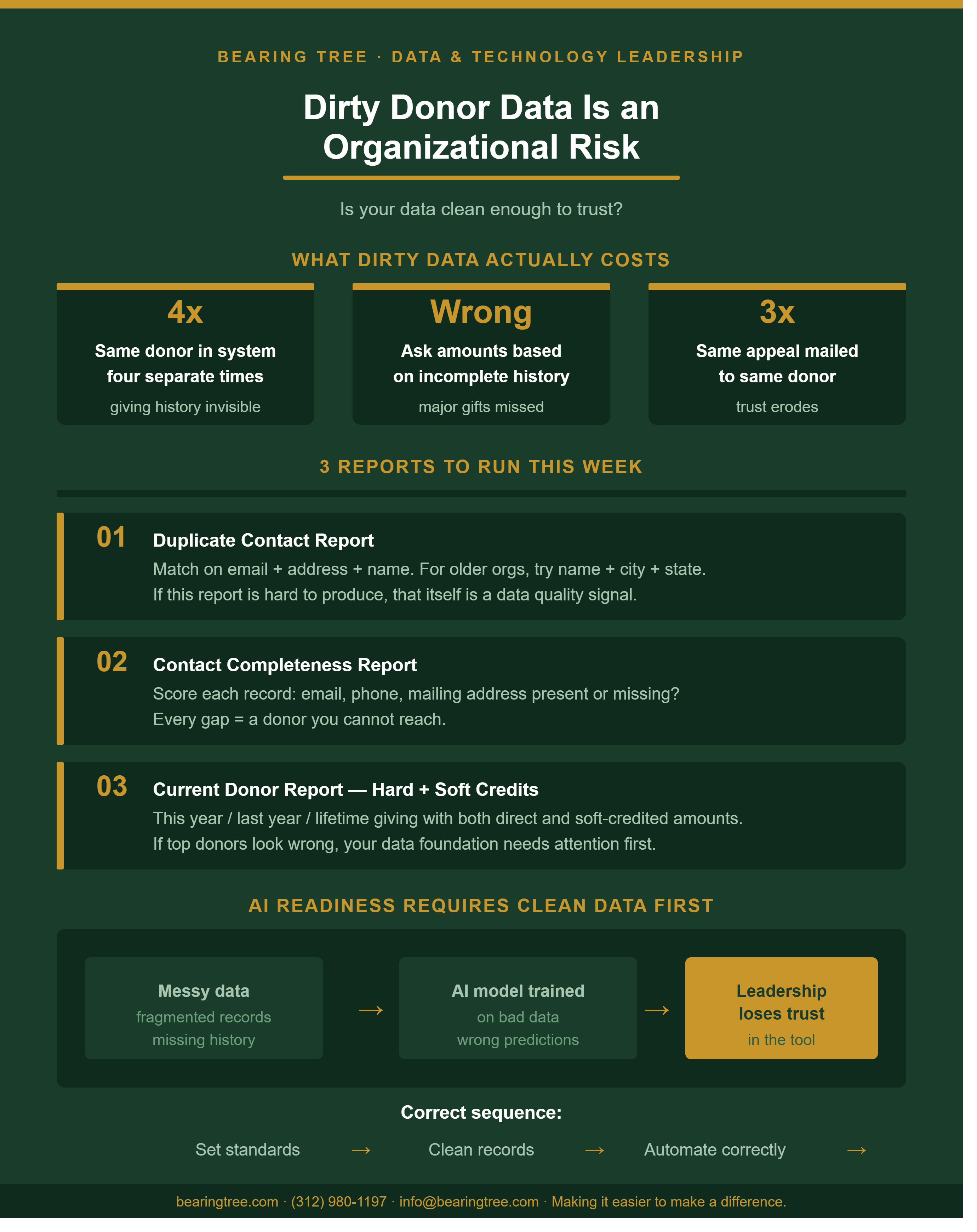
Consider what happens when a donor exists in your CRM four times — four separate contact records, each linked to a different gift. No single record reflects their true giving history. A major gifts officer running a portfolio report sees a lapsed mid-level donor. In reality, that donor has given consistently for a decade at significant levels. The ask amount is wrong. The relationship is underestimated. The opportunity is missed.
Or consider duplicate mailings. The same donor receives three copies of your annual appeal. They don't feel valued — they feel like a data point on a poorly managed list. At worst, they stop giving. At best, they say nothing, and you never know the impression you made.
These aren't hypothetical scenarios. In organizations with legacy databases or high staff turnover, duplicate records and contact fragmentation are common — and they directly undermine the accuracy of every report, every segmentation decision, and every strategy built on that data.
Three Reports Every Leader Should Be Able to Pull
Data quality doesn't require a technology overhaul to assess. It starts with three foundational reports that any CRM should be able to produce:
|
|
1. Duplicate Contact Report Match on email address, mailing address, and full name. For older organizations with long donor histories, also try matching on name plus city and state — donors move, and a name-only match may miss them. If you can't run this report easily, that's information worth having. |
|
|
2. Contact Completeness Report Score each record based on the presence of email, phone, and mailing address. What percentage of your contacts are missing one or more of those fields? Every gap is a donor you can't reach — and every unreachable donor is a relationship at risk. |
|
|
3. Current Donor Report with Hard & Soft Credits Pull this year, last year, and lifetime giving — with both direct gifts and soft-credited amounts included. If your top donors don't look right, or if the report is difficult to generate, your data foundation needs attention before you build anything more sophisticated on top of it. |
If any of those reports are hard to produce, or if the results don't pass the smell test, the issue isn't just operational. It's strategic. You cannot segment accurately, identify lapsed major donors, calculate retention rates, or forecast reliably without a data foundation you trust.
Why AI Makes This More Urgent, Not Less
The sector's enthusiasm for AI-powered fundraising tools is understandable. Predictive giving models, personalized outreach automation, prospect scoring- these capabilities are genuinely powerful. But they are only as good as the data they run on.
An AI model trained on fragmented donor histories will generate fragmented predictions. Ask an AI system to build a personalized outreach plan for a major donor whose record contains no relationship notes, no engagement history, and no communication preferences, and you'll get a generic response that could have been written for anyone.
Garbage in, garbage out has never been more consequential than it is right now. Organizations that invest in AI before cleaning their data will find that leadership loses confidence in the tool quickly, not because the technology failed, but because the data wasn't ready for it.
The correct sequence is: set data standards, clean existing records, automate correctly, then layer in AI. Skipping steps doesn't accelerate results; it just moves the mess faster.
What Responsible Data Leadership Looks Like
For C-suite and director-level leaders, data quality is ultimately a governance question. Someone has to own it, standards have to be set, and there has to be a mechanism for accountability.
That doesn't require a large team or an expensive platform. It requires intentionality. It means running regular data quality checks, not just before an audit. It means building data standards into staff onboarding and performance expectations. It means treating the CRM not as a reporting tool you check occasionally, but as the institutional memory of your donor relationships.
When a gift is processed, a new contact is created, or a relationship note is logged , that action either strengthens or weakens the intelligence your organization has about its donors. Over time, the quality of those micro-decisions determines whether your data is an asset or a liability.
The organizations that treat data as a strategic asset outperform those that treat it as an administrative function. The difference is visible in major gift conversion rates, retention, and the confidence with which leadership can answer the board's questions.
Start Here
If you want a practical first step: pull that current donor report. See if your top donors appear where you'd expect them. If anything looks off, dig into the duplicate report. Start there, with data, not assumptions.
The integrity of your donor relationships lives in your database. It deserves the same leadership attention you give to governance and finance.
This post is based on a conversation with a Bearing Tree development operations leader about data quality, CRM health, and AI readiness in development programs.
Bearing Tree's Development Operations & Research services include Salesforce administration, data clean-up, donor wealth screening, and charitable registration compliance. Learn more at bearingtree.com.
Leave a Reply
Your email address will not be published. Required fields are marked *